
Author: Tim Street
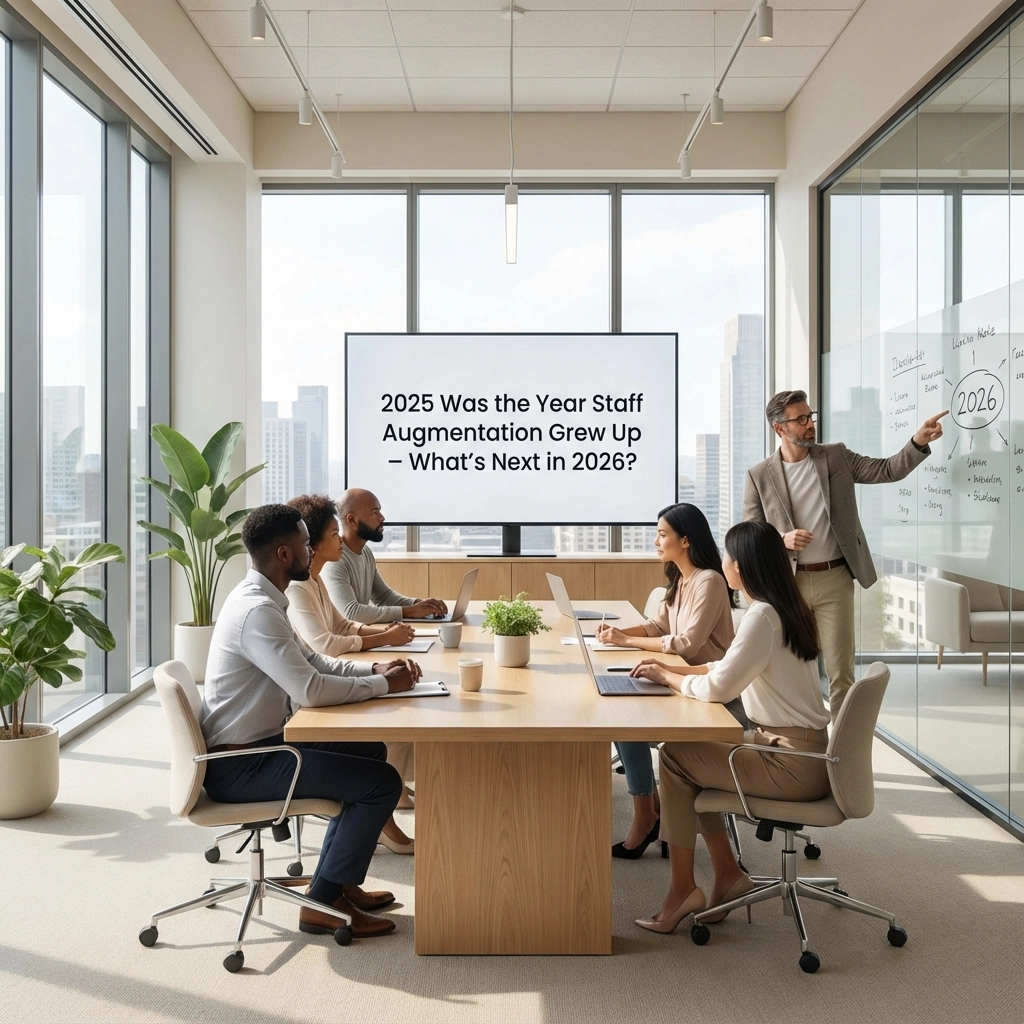
2025 marked a fundamental shift in how enterprise technology leaders approach talent strategy. Staff augmentation evolved from emergency gap-filling to strategic workforce architecture. The layoff-heavy years of 2022-2024 forced a recalibration that fundamentally changed how organisations build, scale, and sustain their engineering capabilities.
As we enter 2026, the question isn't whether staff augmentation works: it's how strategically you're deploying it. The companies that recognised this shift early are already operating with hybrid team models that deliver faster, cost less, and scale more intelligently than traditional hiring approaches.
The 2025 Recalibration: From Reactive to Strategic
The mass layoffs of previous years taught technology leaders a harsh lesson: traditional hiring models are fundamentally broken for modern delivery demands. Long recruitment cycles, inflated compensation packages, and the feast-or-famine nature of permanent headcount created unsustainable operational models.

2025 became the year enterprises stopped treating staff augmentation as a last resort and started viewing it as purposeful team design. Instead of hiring permanent staff for temporary needs or project spikes, forward-thinking CTOs began building core teams supplemented by specialist augmentation capabilities.
This shift wasn't just about cost optimisation: it was about delivery velocity. Traditional hiring cycles of 3-6 months couldn't match market demands for quarterly feature releases and continuous platform evolution. Staff augmentation providers who could deploy skilled engineers within weeks suddenly became strategic partners, not vendors.
AI Reshaping Hiring, Not Replacing Humans
Artificial intelligence fundamentally changed staff augmentation in 2025, but not in the way most predicted. Rather than replacing human engineers, AI tools became force multipliers that made augmented teams more effective and integrated.
The most successful augmentation partnerships in 2025 involved teams fluent in AI-assisted development. Engineers working with GitHub Copilot, automated testing frameworks, and intelligent DevOps pipelines delivered functionality faster than traditional teams working in isolation.
This created a new selection criteria for augmented talent: technical competency plus AI tool fluency. The best staff augmentation partners began providing teams that weren't just skilled in programming languages, but expert in leveraging AI to accelerate delivery cycles.
For 2026, this trend accelerates. Augmented teams that can seamlessly integrate with AI-enhanced workflows will command premium positioning. Those stuck in pre-AI development practices will find themselves increasingly irrelevant.
Enterprises Demand Value-Based Partnerships
The vendor relationship model that dominated staff augmentation for years died in 2025. Enterprises stopped accepting hourly billing for bodies and started demanding accountability for outcomes.

Leading staff augmentation providers pivoted from placement services to delivery partnerships. Instead of supplying individual contractors, they began offering integrated teams with shared responsibility for project success. This meant providing not just technical skills, but project management, quality assurance, and delivery governance.
The procurement criteria evolved accordingly. Technology leaders started evaluating staff augmentation partners on delivery track records, process maturity, and cultural integration capabilities: not just technical CVs and hourly rates.
This shift created a clear division in the market between traditional body shops and strategic delivery partners. Companies that continued operating as talent brokers found themselves competing purely on price, while those that evolved into delivery partners began commanding strategic positioning and premium rates.
The Rise of Hybrid Team Architecture
2025 saw the emergence of hybrid team structures as the dominant operating model for high-performing engineering organisations. Rather than choosing between permanent staff or augmented resources, leading companies began designing teams that strategically combined both.
The most effective hybrid model pairs permanent technical leads with augmented specialist teams. This approach maintains institutional knowledge and strategic oversight while accessing deep expertise and scaled delivery capability without long-term commitment.
Successful hybrid teams operate with shared tooling, unified processes, and collaborative accountability. The artificial distinction between "internal" and "external" resources disappears when teams are properly integrated around common objectives and delivery standards.
This model proves particularly powerful for organisations facing hiring freezes while managing aggressive product roadmaps. Instead of delaying initiatives due to headcount constraints, hybrid teams enable continued delivery velocity by augmenting core capabilities with targeted specialist expertise.

2026 Prediction: Embedded Delivery Model Becomes Standard
Staff augmentation will complete its evolution from stopgap solution to embedded delivery model in 2026. The most strategic organisations will operate with permanently augmented capabilities rather than cycling between internal and external resources based on project demands.
This embedded approach means staff augmentation providers become integral components of technology organisations rather than external suppliers. They participate in strategic planning, contribute to architectural decisions, and maintain long-term relationships that span multiple initiatives.
The embedded model requires staff augmentation partners to operate at enterprise standards for security, compliance, and process governance. Providers unable to meet these requirements will find themselves excluded from strategic opportunities, relegated to tactical project work.
For enterprise technology leaders, this creates an opportunity to access specialist capabilities without the overhead of permanent hiring while maintaining the strategic continuity required for complex platform development.
Practical Implications for Technology Leaders
Rethink Team Design
Move beyond the permanent vs. contractor mindset. Design teams that combine permanent strategic leadership with augmented specialist delivery capability. This hybrid approach provides stability and flexibility without compromising delivery velocity.
Evaluate Partners Strategically
Stop procuring staff augmentation based on hourly rates and individual CVs. Evaluate providers on their ability to integrate with your existing teams, processes, and technology standards. Look for partners who bring delivery governance, not just technical skills.
Plan for AI Integration
Ensure your augmented teams are fluent in AI-assisted development practices. The competitive advantage in 2026 will come from teams that can leverage artificial intelligence to accelerate delivery cycles, not those working with traditional manual processes.
Invest in Integration Processes
Successful hybrid teams require intentional integration practices. Develop onboarding processes, shared tooling standards, and collaborative workflows that enable augmented team members to operate as integral parts of your organisation from day one.
Focus on Delivery Accountability
Shift from hourly billing to outcome-based partnerships. Work with staff augmentation providers willing to share accountability for delivery success, not just provide skilled resources for your management.

Strategic Staff Augmentation as Competitive Advantage
The organisations that recognise staff augmentation as strategic infrastructure rather than tactical hiring will maintain competitive advantage in 2026. This approach enables access to specialist expertise, delivery scalability, and operational flexibility that traditional hiring models cannot match.
The key is selecting staff augmentation partners who operate as strategic delivery partners rather than resource suppliers. Look for providers with proven integration capabilities, delivery governance, and shared accountability for project outcomes.
Staff augmentation has grown up. The question for technology leaders entering 2026 is whether their approach to augmented teams has evolved accordingly. The companies that embrace strategic staff augmentation will outpace those still operating with outdated vendor relationship models.
Strategic workforce planning, AI-enhanced delivery, and embedded partnership models define the future of technology team design. Staff augmentation isn't just part of that future: it's the catalyst that makes it possible.
Ready to explore how strategic staff augmentation can accelerate your technology delivery in 2026? Contact our team to discuss hybrid team models designed for your specific requirements.
Contact Tim Street
- Email: tim.street@finative.dev
- Phone: UK +44 203 959 7423 US: +1 (315) 871 5720
- Book a call: https://meetings.hubspot.com/tim-street6



Leave a comment: