
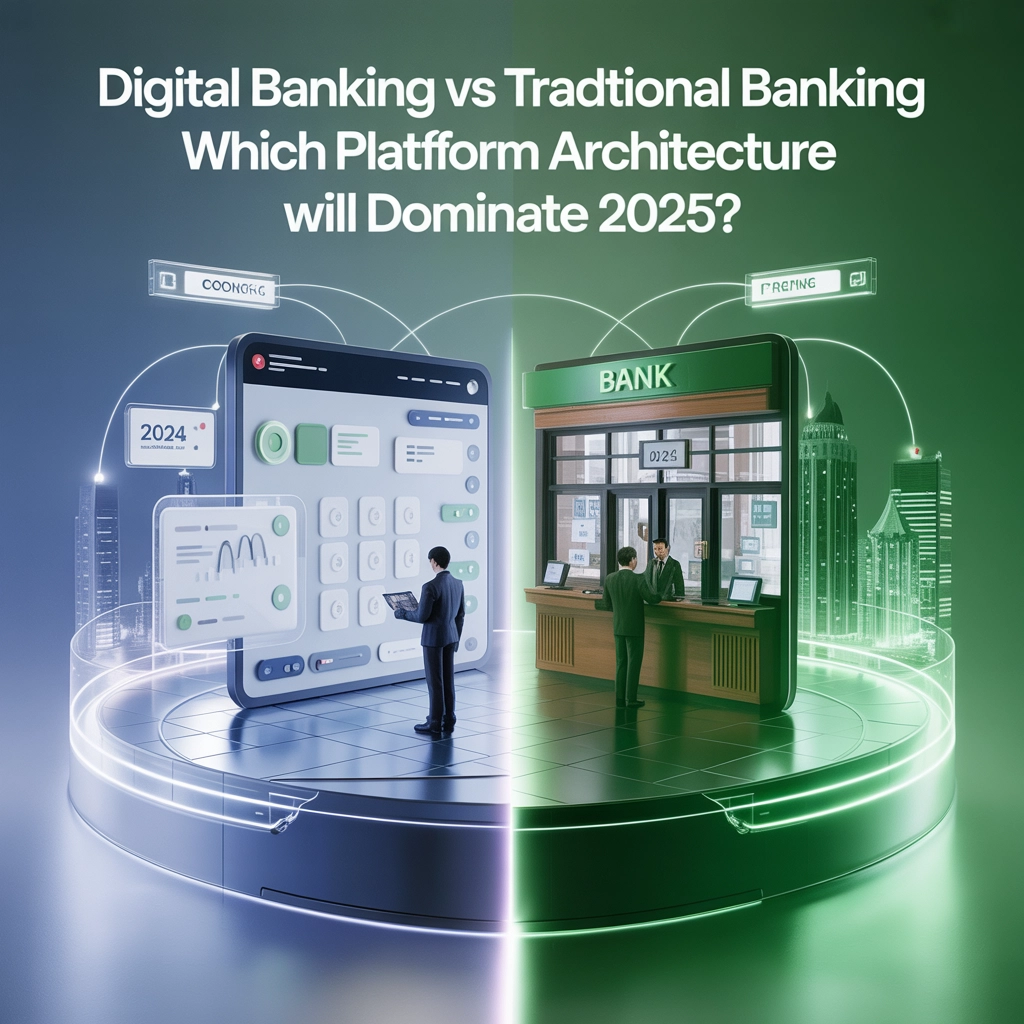
The financial services landscape stands at a critical inflection point. With over 216 million online banking users projected in the United States by 2025, the competition between digital-first and traditional banking architectures has reached unprecedented intensity. This transformation demands strategic evaluation of which platform architecture will deliver superior operational efficiency and customer satisfaction.
Digital Banking Platform Architecture: The Cloud-Native Advantage
Digital banking represents a fundamental shift in financial service delivery, leveraging cloud-native architectures to eliminate traditional constraints. These platforms operate exclusively through digital channels, utilizing advanced AI analytics, automated customer service systems, and mobile-first design principles to deliver round-the-clock banking solutions.

Core Architectural Strengths:
- Cloud Infrastructure Foundation: Enables rapid scalability and deployment of new financial products
- API-First Design: Facilitates seamless integration with fintech ecosystems and third-party services
- Real-Time Processing Capabilities: Delivers instant transaction processing and account updates
- Advanced Analytics Integration: Provides AI-powered financial insights and automated decision-making
- Mobile-Optimized User Experience: Supports 55% of Americans who prefer mobile app banking over traditional computer-based platforms
Operational Advantages:
Digital banking architectures achieve remarkable cost efficiency, reducing operational expenses by up to 70% compared to traditional models. This cost reduction stems from eliminated physical infrastructure requirements, automated customer service processes, and streamlined regulatory compliance systems. The result: competitive interest rates, minimal account maintenance fees, and superior customer value propositions.
24/7 Global Accessibility remains the defining characteristic of digital banking platforms. Customers access comprehensive banking services from any location with internet connectivity, eliminating geographical and temporal constraints that limit traditional banking operations.
Disadvantages and Limitations:
Despite technological superiority, digital banking faces specific challenges. Limited face-to-face customer interaction can impact complex financial consultation requirements. Additionally, complete dependency on internet connectivity and digital literacy may exclude certain customer segments from accessing these advanced platforms.
Traditional Banking Platform Architecture: The Hybrid Integration Model
Traditional banking institutions maintain established physical branch networks while implementing gradual digital transformation initiatives. This hybrid approach combines in-person service delivery with evolving digital capabilities, creating a comprehensive but complex operational framework.

Established Infrastructure Advantages:
- Personal Service Delivery: Face-to-face consultation for complex financial planning and loan applications
- Physical Cash Handling: Direct deposit, withdrawal, and currency exchange services
- Comprehensive Product Portfolios: Full-service banking with human support for specialized financial products
- Regulatory Compliance Legacy: Established frameworks for meeting complex regulatory requirements
- Customer Trust Foundation: Long-standing institutional reputation and relationship management
Operational Challenges:
Traditional banking architectures face significant cost pressures due to physical infrastructure maintenance, staffing requirements, and regulatory compliance complexity. These operational expenses translate to higher customer fees, limited operating hours, and slower transaction processing capabilities compared to digital-native competitors.
Digital Transformation Initiatives:
Progressive traditional banks invest heavily in digital modernization, creating mobile applications, online account management systems, and automated customer service channels. However, these initiatives often operate as add-on services rather than core architectural foundations, limiting their transformational impact.
Platform Architecture Performance Comparison
| Performance Dimension | Digital Banking Architecture | Traditional Banking Architecture |
|---|---|---|
| Operational Cost Efficiency | 70% cost reduction achievable | Higher operational expenses |
| Service Availability | 24/7 global access | Limited by branch hours |
| Transaction Processing Speed | Real-time execution | Variable processing times |
| Account Setup Time | Minutes via mobile application | Branch visits or lengthy online processes |
| Fee Structure | Minimal maintenance costs | Higher fees for infrastructure support |
| Technology Integration | AI-native, mobile-first design | Gradual digital transformation |
| Scalability Potential | Cloud-based rapid expansion | Limited by physical infrastructure |
2025 Market Dominance Indicators
Multiple market indicators demonstrate digital banking's accelerating dominance trajectory. The emergence of pay-by-bank payment systems, widespread cloud computing adoption, and mobile-first customer preferences create an ecosystem favoring digital-native architectures.
Digital Banking Success Metrics:
Leading digital banks demonstrate exceptional growth rates and operational efficiency. State Bank of India's YONO platform achieved profitability within 18 months while acquiring over 26 million customers. Similarly, European digital banks like Revolut and N26 showcase the scalability potential of purely digital architectural approaches.

Traditional Banking Response:
Established institutions recognize digital architecture superiority, creating digital spin-offs and investing billions in technological modernization. Goldman Sachs' Marcus platform and JPMorgan Chase's digital initiatives represent strategic responses to competitive pressure from digital-native challengers.
Technology Integration and Future-Readiness
Digital banking platforms excel in emerging technology adoption, seamlessly integrating artificial intelligence, machine learning, and blockchain capabilities into core operational frameworks. This technological agility enables rapid deployment of innovative financial products and services that meet evolving customer expectations.
Cloud Computing Advantage:
Cloud infrastructure serves as the backbone of modern financial services, enabling digital banks to scale operations globally while maintaining cost efficiency. Traditional banks face significant challenges migrating legacy systems to cloud-native architectures, creating competitive disadvantages in operational flexibility and innovation speed.
AI and Automation Integration:
Digital platforms leverage artificial intelligence for automated customer service, fraud detection, and personalized financial recommendations. These capabilities deliver superior customer experiences while reducing operational costs through process automation and predictive analytics.
Strategic Recommendations for Financial Services Organizations
For Digital-First Implementation:
Organizations prioritizing operational efficiency and customer accessibility should adopt cloud-native digital banking architectures. This approach delivers maximum cost reduction, scalability potential, and technological advancement capabilities essential for competitive positioning in 2025.
For Hybrid Transformation Strategies:
Traditional institutions require comprehensive digital transformation initiatives to maintain market relevance. Successful transformation demands API-first architectural redesign, mobile-optimized customer experiences, and cloud infrastructure migration for core banking operations.
For Technology Partnership Development:
Financial services organizations benefit from strategic partnerships with technology providers specializing in banking platform architecture. These collaborations accelerate digital transformation timelines while ensuring regulatory compliance and operational security requirements.
Conclusion: The Digital Architecture Imperative
The evidence overwhelmingly indicates that digital banking platform architectures will dominate the 2025 financial services landscape. With 70% cost reduction potential, 24/7 service delivery capabilities, and superior technology integration, digital-native platforms offer compelling competitive advantages that traditional architectures cannot match.
Organizations that embrace cloud-native, mobile-first, AI-integrated banking platforms position themselves for sustained market leadership. Those clinging to legacy architectural approaches risk competitive obsolescence in an increasingly digital-first financial services environment.
The question for 2025 is not whether digital banking will dominate, but how quickly traditional institutions can complete their digital transformation to remain competitive. The architectural foundation you choose today determines your organization's ability to thrive in tomorrow's financial services ecosystem.
Stay ahead of the digital banking revolution. Explore how Finative's bespoke IT solutions can accelerate your financial services platform transformation and deliver the operational efficiency your organization demands.




Leave a comment: